
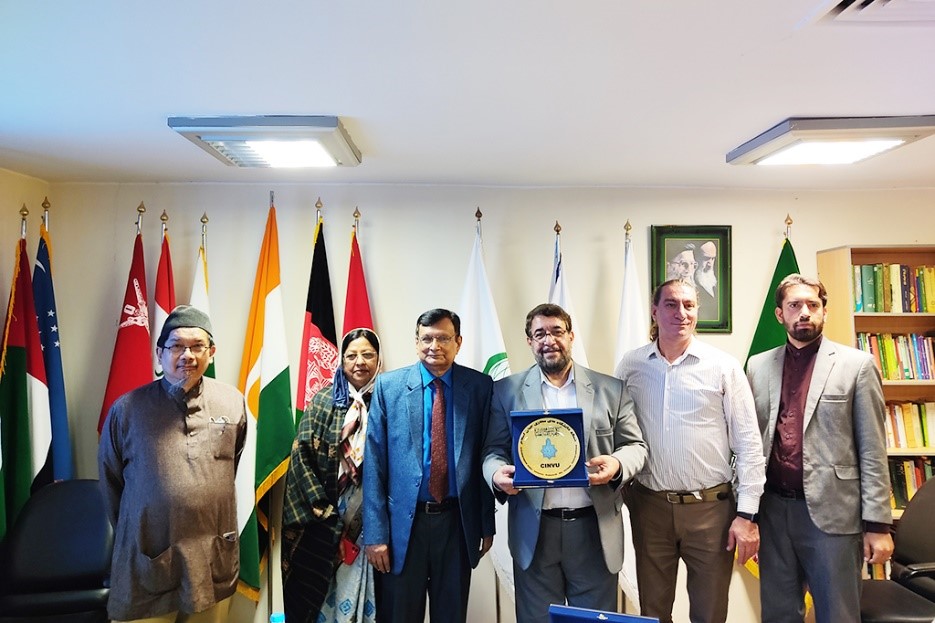
The Secretary General of CINVU met with the Heads of Universities of Islamic Countries
- 2021/10/20
Referring to the use of virtual education by more than 30 million students, the Secretary General of CINVU stressed the adoption of a development-oriented approach in using all capacities of e-learning to strengthen communication between elites, thinkers, universities and Islamic countries.
According to the Public Relations Report of CINVU, on the first day of Unity Week and simultaneously with the 35th Islamic Unity Conference and on the eve of awarding the Mustafa International Prize by the Islamic Republic of Iran to scientists of the Islamic world, a number of heads of top universities First, the Islamic countries that have traveled to Tehran to participate in the international ceremony of the Mostafa (PBUH) Award accepted the membership of this scientific and technological institution of the Islamic world by attending the office of CINVU on behalf of their universities.
In this event, Dr. Karim Najafi Barzegar, Secretary General of CINVU, while commemorating the Week of Unity and congratulating the birth of the Prophet Mohammad Mustafa (PBUH), stated that CINVU has covered 57 Islamic countries, currently, more than 30 million students are undergoing virtual education, so in the context of the constraints of the Corona epidemic, we must take advantage of the development-oriented capabilities of virtual education to strengthen communication between elites, thinkers, universities and Islamic countries to achieve the lofty goal of creating a new Islamic civilization.
Dr. Najafi Barzegar further called unity the key to the victory of the Islamic world and the victory and continuation of the Islamic Revolution and said: "Unity diplomacy is one of the most important policies of the present age, which is always emphasized by Imam Khomeini and the Supreme Leader, it has been because global arrogance is targeting the unity of the Islamic world and trying to create divisions between religions and Islamic sects.
The Secretary General of CINVU called reliance on unity one of the most important goals of scientific and academic diplomacy in Islamic countries and added: Establishing connections between universities in the Islamic world, elites and Islamic scholars will bring about exchange and interaction to strengthen the scientific and technological growth of Islamic countries.
Dr. Najafi Barzegar emphasized: We are sure that the need of Islamic countries for Western countries will cause damage to Islamic unity, so it is necessary to use scientific, technological and academic capacities in order to avoid the influence of global arrogance and for the growth of Islamic countries.
Dr. Faridul Alam, Vice Chancellor of Bangladesh University of Health Sciences, Dr. Mohammad Deniz from Dokuz Eylul University of Turkey, Dr. Van Ahmad from National Centre For Particle Physics of Malaysia, Dr. Osman Hassan from National University of Sciences & Technology of Pakistan and Dr. Alam from Bangladesh University Were present.
Accordingly, strengthening the cooperation and benefit of Muslim professors, students and researchers from academic, scientific and technological capacities was the focus of the discussions held at this event.
Notably, the COMSTECH Inter-Islamic Network on Virtual Universities (CINVU) is an international educational, research, knowledge-based, and technology network affiliated with the Ministerial Standing Committee on Scientific and Technological Cooperation of the Organization of Islamic Cooperation (COMSTECH), which is hosted by the Ministry of Science, Research, and Technology of the Islamic Republic of Iran.
With the idea of creating educational equity, CINVU is a base for expanding universal public education based on smart and online technology that by networking of capacities, uses the power of education, research, innovation, and technology, in line with the approach of helping to empower and advance the countries of the Islamic world.
With the idea of creating educational equity, CINVU is a base for expanding universal public education based on smart and online technology that by networking of capacities, uses the power of education, research, innovation, and technology, in line with the approach of helping to empower and advance the countries of the Islamic world.
Referring to the use of virtual education by more than 30 million students, the Secretary General of CINVU stressed the adoption of a development-oriented approach in using all capacities of e-learning to strengthen communication between elites, thinkers, universities and Islamic countries.